From Fan Mail to Fan Forums: A Short History of Music Fandom
Music fandom has moved from letters and fanzines to forums and group chats; see how each channel helped listeners find one another and share enthusiasm.
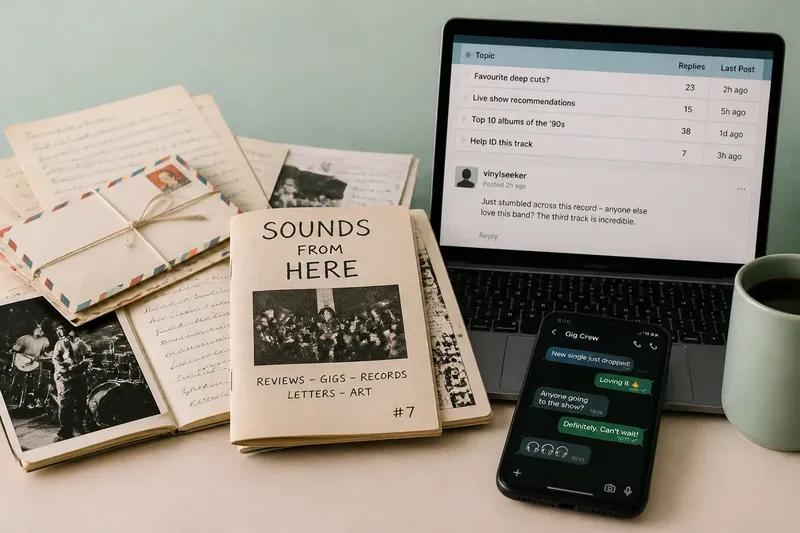
Music fandom has always depended on a way to reach another listener. Music fandom once travelled by letter, folded fanzine and noticeboard; now it can move through a forum thread or group chat before a record has finished playing. Each channel changed not only the speed of conversation, but who could join it and what fans could share.
This history is best understood as a change in the shape of communication, not a parade of devices replacing one another. New channels made some exchanges easier and left others intact. A letter could carry a carefully chosen clipping; a forum could gather replies from people who would never meet in the same room.
What did fan mail make possible?
Before digital networks, fans often found one another through the existing machinery of music culture: an address printed in a magazine, a record-club mailing list, a concert notice or a friend’s introduction. Writing meant choosing words, finding paper and waiting for a reply. That delay gave correspondence a deliberate quality.
Letters could include photographs, copied lyrics, reviews and recommendations. Fans sometimes wrote to performers or publishers, but correspondence between listeners mattered too. A shared postal address in a newsletter could turn an isolated reader into part of a small, distributed conversation.
The limitation was access. Fans needed a reliable postal route, the means to send letters and some clue that another person wanted to hear from them. The exchange could be intimate, but it rarely grew quickly. The envelope was both a connection and a boundary.
How did fanzines widen the conversation?
Fanzines took personal enthusiasm and made it reproducible. A fan could gather letters, reviews, drawings, gig reports and photocopied material into an issue, then send or sell copies through mail order, shops and concerts. The result was not a polished magazine in miniature. Its uneven pages often made the editor’s hand visible.
That visibility mattered. Readers could see that someone else had cared enough to assemble a publication, and could respond by writing in, contributing art or making a zine of their own. A fanzine created a small public without requiring a broadcaster’s permission. It also asked for work: editing, copying, addressing envelopes and finding places to distribute copies.
Say a reader receives a fanzine through a record-club address and notices that its back page invites letters. They send a short review and ask to swap issues. If the editor prints the note in a later edition, the reader has moved from audience to contributor, while the exchange remains tied to the slow rhythm of print and post.
What changed when fan forums arrived?
Online forums gathered conversations around a shared subject and kept them visible to later arrivals. A thread could collect recommendations, interpretations, collection notes and practical questions in one place. Unlike a letter sent to one person, a post might receive responses from several readers, while others could follow along without speaking.
That structure altered the scale of fandom. People no longer needed a shared town, venue or mailing list to discover one another. Searchable archives also let a new member find older discussions, although the usefulness of an archive depended on how well it was organised and maintained.
Forums had their own etiquette and friction. Usernames offered some distance; moderators and community rules set boundaries. A long-running thread could build its own vocabulary, which helped regulars communicate but could make newcomers feel as though they had arrived halfway through a conversation. The noticeboard had become searchable, not automatically welcoming.
Why did social media and group chats feel different?
Social platforms made music fandom more immediate and more mixed together. A fan might post a photograph of a record, share a link, react to a performance clip and answer a friend in the same feed. The same account could connect close friends, strangers and public figures, with each audience overlapping in ways that were not always obvious.
Group chats brought the exchange closer to private conversation. Friends could pass around a new track, argue over a set list or arrange to meet, without composing a public post. Their speed and informality suited quick reactions, but useful recommendations could disappear beneath later messages. A forum tended to preserve a topic; a chat tended to preserve the feeling of being there together.
These channels did not simply make fandom larger. They changed what counted as participation. A short reaction, shared link or emoji could signal attention, while print-based fandom had asked for a more visible contribution. Neither form tells the whole story of how much someone cares.
Which music fandom channel suits which kind of exchange?
Why do fans still send letters or zines?
Print suits material that benefits from selection and keeping: a personal note, a collage, a review or a small collection of contributions. It takes more preparation than a post, but the finished item can be read away from a screen and passed to someone else.
Are forums better for detailed discussion?
A forum often suits questions that need context, several replies or a reference point for later readers. Threads make it easier to follow one subject, though a quiet forum may receive slower replies than a busy chat.
When is a group chat useful for music fans?
A group chat works well for familiar people sharing quick reactions or making plans. It is less suited to material that needs a lasting, searchable home, since messages can scroll out of view.
How can fans keep online conversation welcoming?
Explain unfamiliar shorthand, leave room for different levels of knowledge and disagree with the point rather than the person. A community can also make its expectations visible, so newcomers do not have to infer every rule from old arguments.
What has stayed constant across the channels?
The tools have changed, but the basic exchange is recognisable: one listener offers something another listener might value. It could be a letter, a clipped review, a link or a message naming a record worth hearing. The channel shapes the exchange by setting its pace, audience and lifespan.
Each medium also leaves a different trace. A letter preserves a one-to-one exchange; a fanzine records a group’s chosen voice; a forum stores public discussion; a chat captures passing company. None is a complete record of a fandom, because much of its life happens in conversation that is never saved.
Music fandom’s history, then, is not a clean march from paper to screen. Old forms persist beside newer ones because they answer different needs. The useful question is not which channel wins, but what kind of connection it makes possible—and what it asks fans to contribute in return.